
Pablo Picasso: Eccentric Genius, Tumultuous Relationships and a Legacy of Misogyny
Pablo Picasso (1881–1973) stands as one of the most influential artists of the 20th century, a co-founder of Cubism whose innovative styles revolutionised modern art. Born in Málaga, Spain, Picasso’s prolific career spanned over seven decades, producing thousands of paintings, sculptures, ceramics, and prints that captured the fragmentation of human experience, the horrors of war, and the complexities of emotion.
Yet, beneath his artistic brilliance lay a deeply eccentric personality that manifested in erratic behaviours, an unyielding drive for creation, and a profoundly problematic approach to personal relationships. Many years ago in college, when we were discussing Picasso in GP class, we focused only on his art and his genius. His private life and his eccentricities were talked about with a smile. Interestingly, today’s focus seems to have changed to zoom in on Picasso’s eccentric nature, his intricate web of romantic entanglements and his misogynistic attitudes toward women. It’s not that we didn’t know all this in the past, but critics today are a lot less forgiving and a lot more judgmental.

Eccentricity As Necessity
Since ancient times, the Chinese have recognised that certain personality defects come with genius. From his earliest years, Picasso exhibited traits that set him apart as an eccentric figure, blending prodigious talent with unconventional habits and a rebellious worldview. As a child in Málaga, he displayed an innate artistic ability, reportedly learning to draw before he could speak properly. His father, an art teacher, recognised this precocity and encouraged it. Young Pablo eschewed formal education. In school, he demonstrated an utter lack of discipline and a refusal to follow instructions. This anti-authoritarian streak matured into a lifelong disdain for convention and control. Picasso skipped school often. His knowledge and literacy were almost entirely self-taught.
His eccentricity extended to his daily life and creative process. Picasso was notoriously restless, with thoughts, sensations, and memories constantly fermenting within him. He expressed himself in extremes and contrasts, attaching only to what he deemed essential while discarding the minor. Biographers describe him as a “sum of curiosities,” more inquisitive than “a thousand million women,” driven by discovery rather than premeditation. This manifested in peculiar habits: he often worked naked during sweltering summers in his Paris studio, the Bateau-Lavoir, to combat the heat. He had a penchant for animals, treating dogs as constant companions and muses.

Picasso’s behaviour could veer into the destructive and impulsive. He was known for creating artworks only to demolish them in fits of dissatisfaction, reflecting a volatile temperament. His flamboyance and narcissism drew divided opinions. Some saw him as a playful genius, while others viewed him as a narcissistic misanthrope who “gobbled up” friends, employees, and lovers like visual stimuli. Like Chinese 才子, he was addicted to work, sex, and tobacco. His bohemian lifestyle and disdain for decorum clashed with societal norms. Few people could get along with him.
Picasso’s Relationships: A Web of Passion, Overlap, and Turmoil
Picasso’s romantic life was as prolific and fragmented as his Cubist canvases, involving two marriages, six long-term mistresses, and countless affairs that often overlapped in a chaotic tapestry. His relationships were intense, passionate, and frequently destructive, with women serving as both emotional anchors and artistic muses. Scholars note that his styles evolved with each new lover, categorizing his work into periods defined by these women: Fernande Olivier for the Rose Period, Marie-Thérèse Walter for Surrealism, and so on.

His first significant Parisian romance was with Fernande Olivier (1904–1912), a model who inspired many Rose Period works with her warmer, romantic aesthetic. Their relationship was marked by Picasso’s intense jealousy, leading him to isolate her as a “recluse.” After Olivier, he briefly partnered with Eva Gouel (1912–1915), whose death from illness devastated him. In 1918, he married Russian ballet dancer Olga Khokhlova, with whom he had son Paulo. Their union began romantically but deteriorated due to clashing lifestyles—Olga’s social propriety versus Picasso’s bohemianism—leading to separation in 1935, though they remained legally married until her death in 1955.
Overlapping with Olga was Marie-Thérèse Walter, whom Picasso met when she was 17 and he 45. She became his “golden muse,” mothering daughter Maya (born 1935) and inspiring erotic, surrealist pieces like Nude, Green Leaves and Bust (1932). Their affair involved secrecy and power imbalances; Picasso rented a cabana near her girls’ summer camp for clandestine meetings. By 1935, photographer Dora Maar entered his life, documenting his masterpiece Guernica (1937) while enduring emotional torment in a “tormented” relationship that ended around 1943.

Françoise Gilot (1943–1953), a painter 40 years his junior, bore him two children, Claude and Paloma. She later detailed their decade together in Life with Picasso (1964), describing his infidelities, cruelty, and control. Gilot was the only woman to leave him, stating she was “not a submissive woman.” Her book sold over one million copies in dozens of languages, notwithstanding an unsuccessful legal challenge from Picasso attempting to stop its publication. All the profits from the book were used to help their children Claude and Paloma mount a case to become Picasso’s legal heirs.

Finally, Jacqueline Roque became his second wife in 1961, after meeting in 1952. Their marriage lasted until his death, but she too complained about “isolation and control”.
Picasso’s Misogynistic Attitude: Goddesses, Doormats, and Machines for Suffering
Picasso’s treatment of women resurfaced with the #MeToo era, where his legacy was reexamined for patterns of abuse, manipulation, and objectification. His infamous quote to Gilot—”For me there are only two kinds of women: goddesses and doormats” simplistically encapsulates how a wicked but casual remark could be used against someone famous. He further told Gilot that women are “machines for suffering”. Was he the sadist or the masochist?
Other biographical accounts paint a shocking picture. Granddaughter Marina Picasso described how he “submitted them to his animal sexuality, tamed them, bewitched them, “ingested” them, and crushed them onto his canvas. After… extracting their essence, once they were bled dry, he would dispose of them.” Picasso, My Grandfather (2001) Marina happens to be a humanitarian who grew up in poverty but later inherited 10,000 pieces of Picasso’s works. She had accused her uncle Claude Picasso (administrator of the Picasso Estate) of treating “one of the greatest painters, a genius,” disrespectfully.
When people around you keep dying. You know there could be something wrong with you. Critics find “evidence” of exploitation in the fates of Picassso’s partners: Marie-Thérèse hanged herself in 1977; Jacqueline shot herself in 1986; Olga and Dora suffered nervous breakdowns; Paulo died from alcoholism in 1975; and grandson Pablito swallowed bleach in 1973 after being barred from Picasso’s funeral by Jacqueline. Somehow, it’s the dead man’s fault that Paulo drank himself to death and Pablito killed himself with bleach. Gilot’s memoir highlights his “total absence of empathy,” lack of remorse, and pattern of seduction as power exertion, traits some liken to psychopathy”. The highly assertive wife Jacqueline would probably have written something similar.
Critics argue that Picasso’s misogyny infused his art where women appear as contorted figures—bowls of fruit or praying mantises—reflecting “Here’s the hole” or “There’s the harpy.” To make a politically correct statement, exhibitions like the Brooklyn Museum’s “It’s Pablo-matic” (2023) were held to counter Picasso’s distasteful attitude, but was his sexism intrinsic to his creation? Defenders, like some biographers, suggest he was “as much sinned against as sinning,” a product of his Andalusian (Southern Spain) culture, or he no worse than contemporaries. He lived in the pre-James Bond era. Next on the chopping board could be Ian Fleming and James Bond movies could be cancelled. Nevertheless, accounts of Picasso preying on young women in cafés, emotional domination and discarding them sold very well. Too many curious members of the public were disgusted but engaged.
Picasso’s Inspiration
Nevertheless, it needs to be understood that Picasso’s eccentricity and misogyny cannot be separated from his genius. His restless curiosity drove innovations like Cubism, while his relationships provided emotional raw material, shifting styles with each muse. Works like The Weeping Woman (1937), inspired by Maar, capture anguish that mirrored real suffering. His legacy endures as a testament to genius’ double edge: unparalleled creativity shadowed by profound human failings. In the context of modern feminism, particularly since the rise of the #MeToo movement in 2017, his influence extends beyond aesthetics into the realm of cultural and moral critique.
In spite of the fact that Picasso was a flamboyant “open book” who had no need for clothes at home, his relationships with women were often described as “exploitative” even though none of the women who jumped into his bed could have thought that Pablo Picasso was some sensitive new age guy. His artworks, often depicting women in distorted, objectified forms, have become labelled as emblems of patriarchal power structures in the art world. At the turn of the century, feminist scholars, artists, and curators began to challenge the “male genius” myth and the “artistic licence” that they have been accorded. Female artists who have been as successful if not more successful than Picasso are now painted as victims of male suppression. The result is a form of cultural revolution. In place of the red armbands, are trendy hashtags on social media.
Can Picasso Make Men Misogynist?
Picasso’s art, prolific with over 50,000 works, frequently features women in fragmented, distorted forms that feminists interpret as manifestations of misogyny. In pieces like Les Demoiselles d’Avignon (1907), prostitutes are rendered angular and mask-like, drawing from African and Iberian influences to create “fearsome” figures that subvert traditional nudes. Female psychologists accuse him of trying to “exoticise” and “dehumanise” women. Later works, such as Seated Woman (1929) or Nude Woman in a Red Armchair (1932), have been interpreted as attempts to fuse women with objects, making then pliable mediums for male creativity. I’m not a psychologist but these feminists seem to be able to read Picasso’s mind from his works of art.

Australian feminist academic Kate Manne believes that Picasso’s deliberate distortion of women’s bodies is an attempt to punish them for having their own minds. Not surprisingly, other feminists have come forward to suggest that his distortion of the female form could be an attempt to twist conventional stereotypes. Yet another side highlighted his appropriation of African masks in his paintings as signs of racism and cultural imperialism alongside gender discrimination! Feminist and other woke intellectuals in today’s cultural revolution are studying Picasso’s works not for their artistic merit but to pinpoint features in his art that corrupt our minds and perpetuates race and gender myths.
Contemporary Exhibitions and Reevaluations: #MeToo and the Art World’s Reckoning
Picasso’s centenary in 2023 marked a turning point, with global exhibitions “reevaluating” his legacy through the lens of feminism. The Brooklyn Museum’s “It’s Pablo-matic: Picasso According to Hannah Gadsby” (2023), curated by comedian Hannah Gadsby with Lisa Small and Catherine Morris, exemplifies this. Gadsby, whose 2018 Netflix special Nanette critiqued Picasso’s Cubism for lacking women’s perspectives. She juxtaposed over 100 of his works with those by female artists like Käthe Kollwitz, Ana Mendieta, and Mickalene Thomas in an attempt to balance and correct perceptions.

The show reframes modernism’s “ossified” narratives, questioning why institutions like the Picasso Museum in Paris still laud Picasso as a great artist. The #metoo and other inclusivity movements have triggered a cultural revolution against previously lauded artists just as some other woke groups campaign against “ossified” past leaders and war heroes.

Reply With A Painting
Denying that they are riding on Picasso’s fame, some modern female artists (especially those from minority ethnic groups) create “replies” to Picasso’s supposedly misogynist works. Interestingly, they don’t see themselves as having hijacked Picasso’s fame but as teachers correcting his “erroneous” views and attitude.
On social media, discussion on Picasso often attract trolls who know nothing about art but frame Picasso as a “womanizer” with no redeeming features. Activists demand policy shifts. Museums are required to tag artists’ misbehaviour. Artists are not judged based on their artistry but their morals. “Ethical collecting” takes on a whole new meaning.
The Art Of Cancelling
Artists of the future, be they visual artists, musicians, filmmakers or writers must cultivate woke values and be good role models even before they dip their brushes in paint or their works may be judged as lousy or even harmful and get cancelled by the righteous woke. How about a bit of inclusivity and understanding for the eccentric talents?

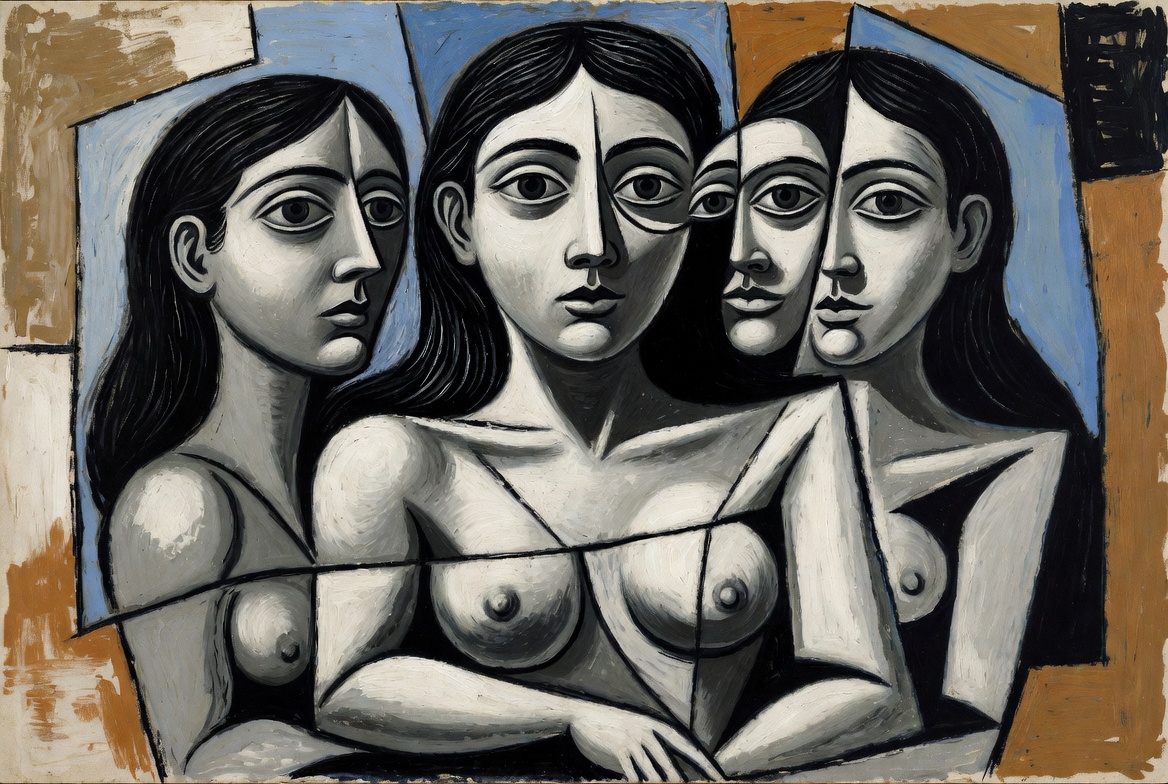
The following are AI creations in the style of Picasso, emphasizing his misogyny and objectification of women. I don’t know about you, but I see the depth and volume of his message. The fracture, the distortion and the deformity cast his frustration with an overbearing and unreasoning woman at one point in time. It resonates with many people but the woke feels that it must be denied and cancelled. These “paintings” were created by AI. Don’t slap labels on me. I’m not Picasso.


Dewdrop Books – Fiction and non-fiction with a focus on the colourful and exotic Asian realm. Check out our titles.